
Claude Opus 5 vs Opus 4.8: What You Actually Get for the Same Price
Same $5 per million input tokens. Up to 2x the benchmark performance. Here is where the gains are real and where they are not.
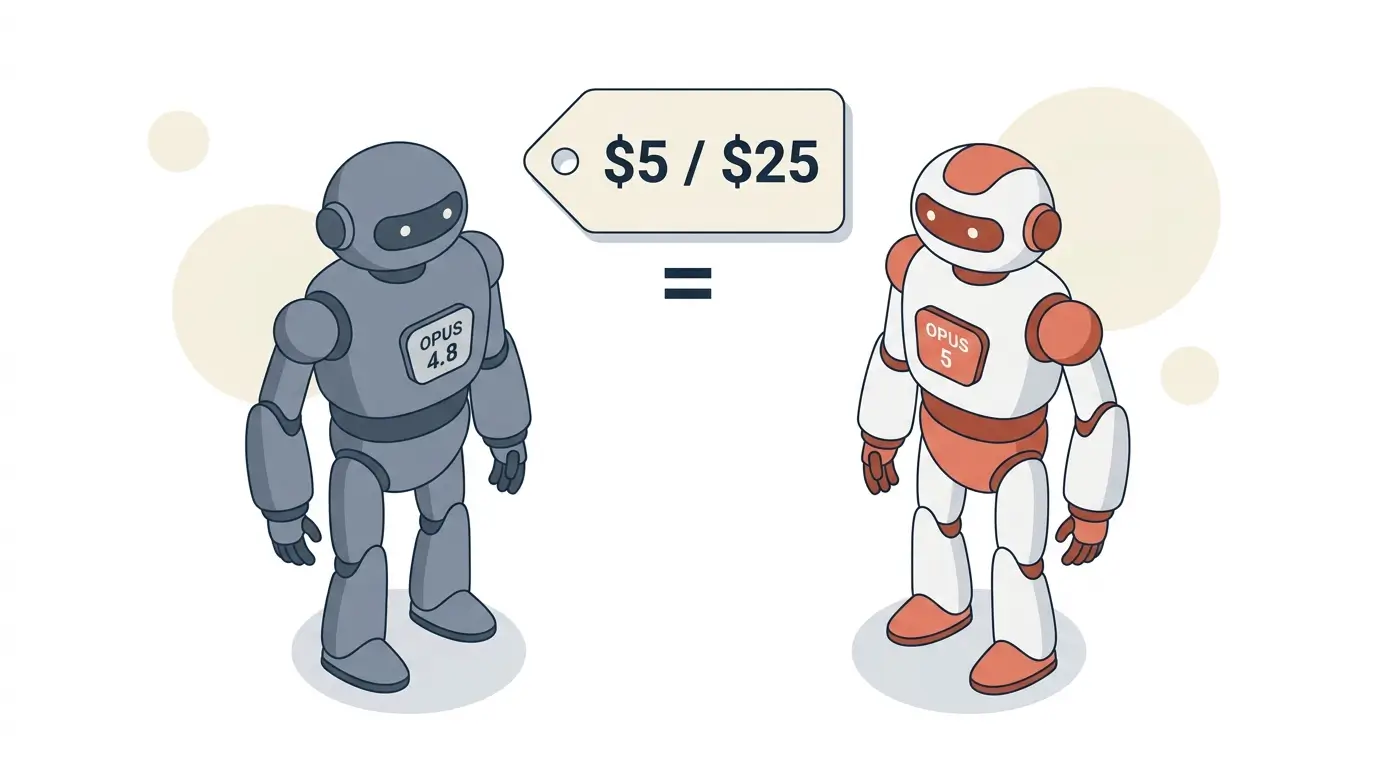
I just noticed Claude Opus 5 drop into my Genspark account. I get to use it there for free with unlimited chats. But if you pay for API access, Opus 5 carries the exact same price tag as Opus 4.8.
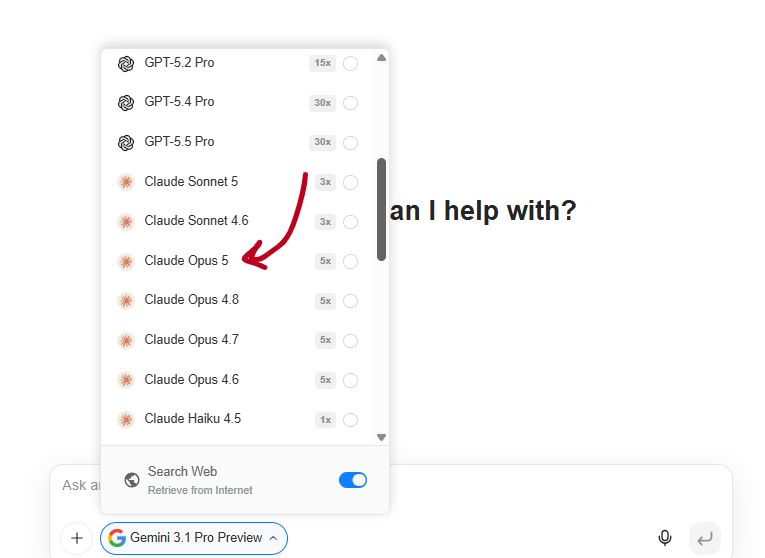
But, which one is the best? I’ve went down the rabbit hole for you..
The Short Answer
- Claude Opus 5 is Anthropic’s newest high-end model. It costs exactly what Opus 4.8 costs: $5 per million input tokens, $25 per million output tokens [1].
- It scores more than 2x higher than Opus 4.8 on Frontier-Bench v0.1, a software engineering benchmark, at a lower cost per task [1].
- It is the default model on Claude Max and the strongest model on Claude Pro [1].
- If you already use Opus 4.8, switching is a strict upgrade. Two exceptions: offensive cyber work, and workloads light enough for Sonnet 5.
What Is Claude Opus 5?
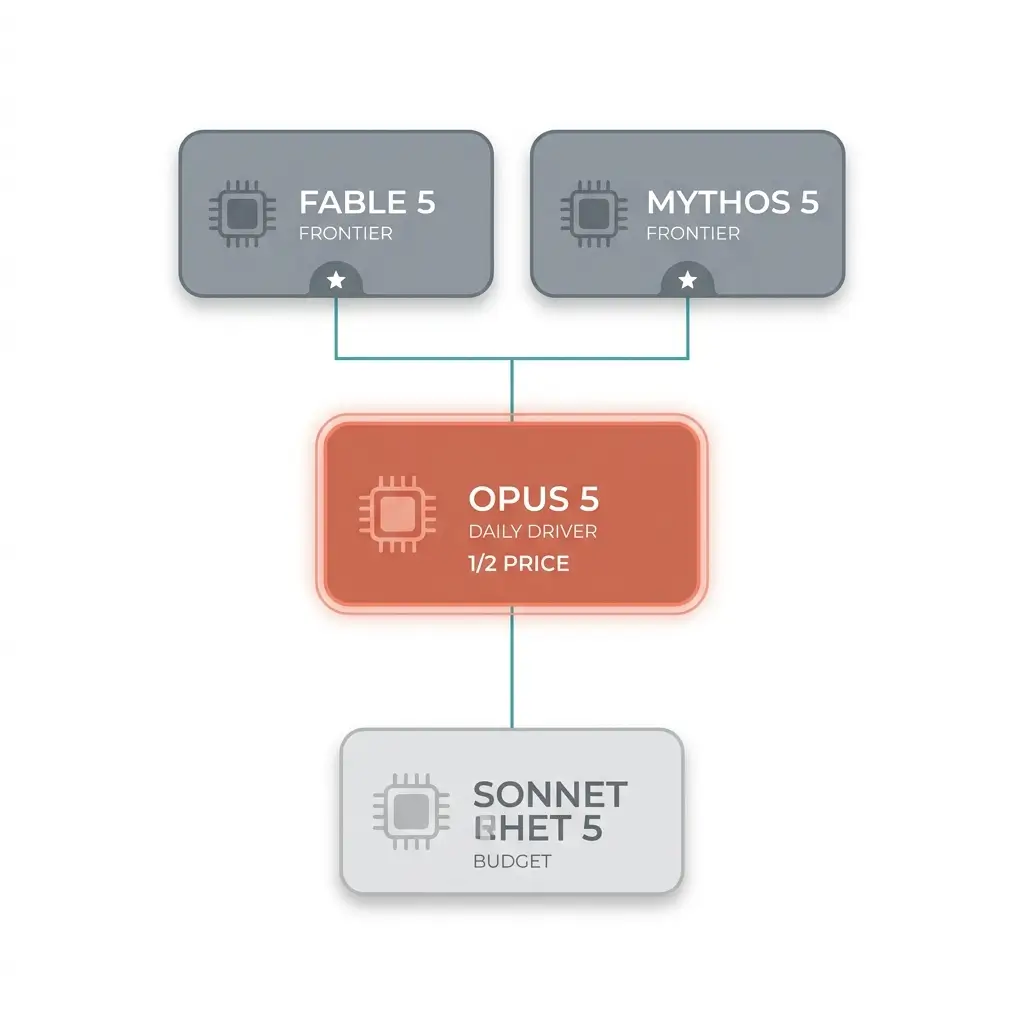
Anthropic’s lineup now has three tiers at the top. Fable 5 and Mythos 5 sit at the frontier. Claude Opus 5 sits one step below as the high-end model built for daily use, at half the Fable 5 price [1][5].
Sonnet 5 covers the cheaper end. Opus 4.8 launched earlier as the previous high-end daily driver in this same slot [4].
Opus 5 = near-frontier intelligence at half the Fable 5 price.
It is the default on Claude Max and the strongest option on Claude Pro [1].
Anthropic built it for people who run models all day and bill for the output: developers, analysts, researchers, founders.
What Claude Opus 5 Is Good For
Agentic Coding
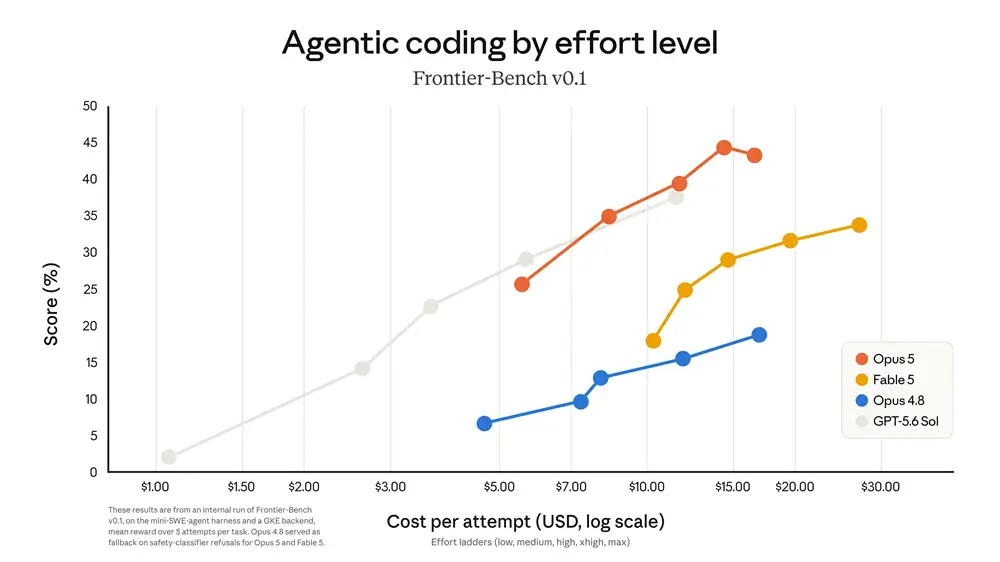
This is the headline. On Frontier-Bench v0.1, Opus 5 sets the state of the art and more than doubles Opus 4.8’s performance at a lower cost per task [1].
On CursorBench 3.2 at maximum effort, it lands within 0.5% of Fable 5’s peak score while costing half as much per task [1].
Benchmarks are one thing. Behavior is another. On one Frontier-Bench task, Opus 5 received a drawing of a machine part and instructions to rebuild it as a 3D FreeCAD model.
The catch is that it had no way to view the drawing. So it wrote its own computer vision pipeline, extracted the geometry from raw pixels, and reconstructed the full part. It succeeded on multiple attempts. Competing models attempted the same task five times each. NOT ONE solved it [1].
(Ed. note: That FreeCAD task is the single best illustration of what “agentic” means in practice. The model hit a wall and built the tool it needed to get past it.)

Sound like marketing copy? The benchmark setup and scoring details are published alongside the results [1].
Long-Running Autonomous Work
Opus 5 verifies its own output and iterates until a task succeeds, instead of declaring victory after one pass [1][2]. On Zapier’s AutomationBench, which measures whether a model can complete real business tasks from start to finish, its pass rate runs about 1.5x the next-best model at the same cost per task. Even at its lowest effort setting (a control that trades intelligence for speed and cost), it passes more tasks than every other model tested [1].
Practical translation: you hand it a workflow, it hands you back a finished one. Less babysitting = more tasks shipped per day.
Computer Use
On OSWorld 2.0, which tests models operating real computers, Opus 5 outperforms every other model at any given cost. It beats Fable 5’s best result at just over a third of the cost [1]. If you run browser agents or desktop automation, this is the strongest price-performance point available.
Knowledge Work and Analysis
On ARC-AGI 3, an evaluation built around novel problems the model has never seen, Opus 5 scores three times higher than the next-best model [1]. Early enterprise testers report the same pattern on vague, open-ended work: financial modeling, legal redlining, due diligence [1]. These are tasks where the prompt is under-specified and judgment fills the gaps. That is exactly where 4.8 used to wobble.
Scientific Research
Opus 5 beats Opus 4.8 on every life sciences evaluation Anthropic ran, covering structural biology, organic chemistry, and bioinformatics. The largest gains: 10.2 percentage points higher on inferring molecular structures from spectroscopy data, and 7.7 points higher on predicting how protein sequence variants affect function [1].
Visual Output
Front-end builds, animations, games, 3D scenes, and slide decks all come out cleaner than 4.8’s [1]. If you use Claude for design-adjacent work, you will notice this within a day.
Opus 5 vs Opus 4.8: The Numbers
Same price. Better output. The full comparison:
| Metric | Opus 4.8 | Opus 5 |
|---|---|---|
| API price per 1M tokens (input / output) | $5 / $25 | $5 / $25 |
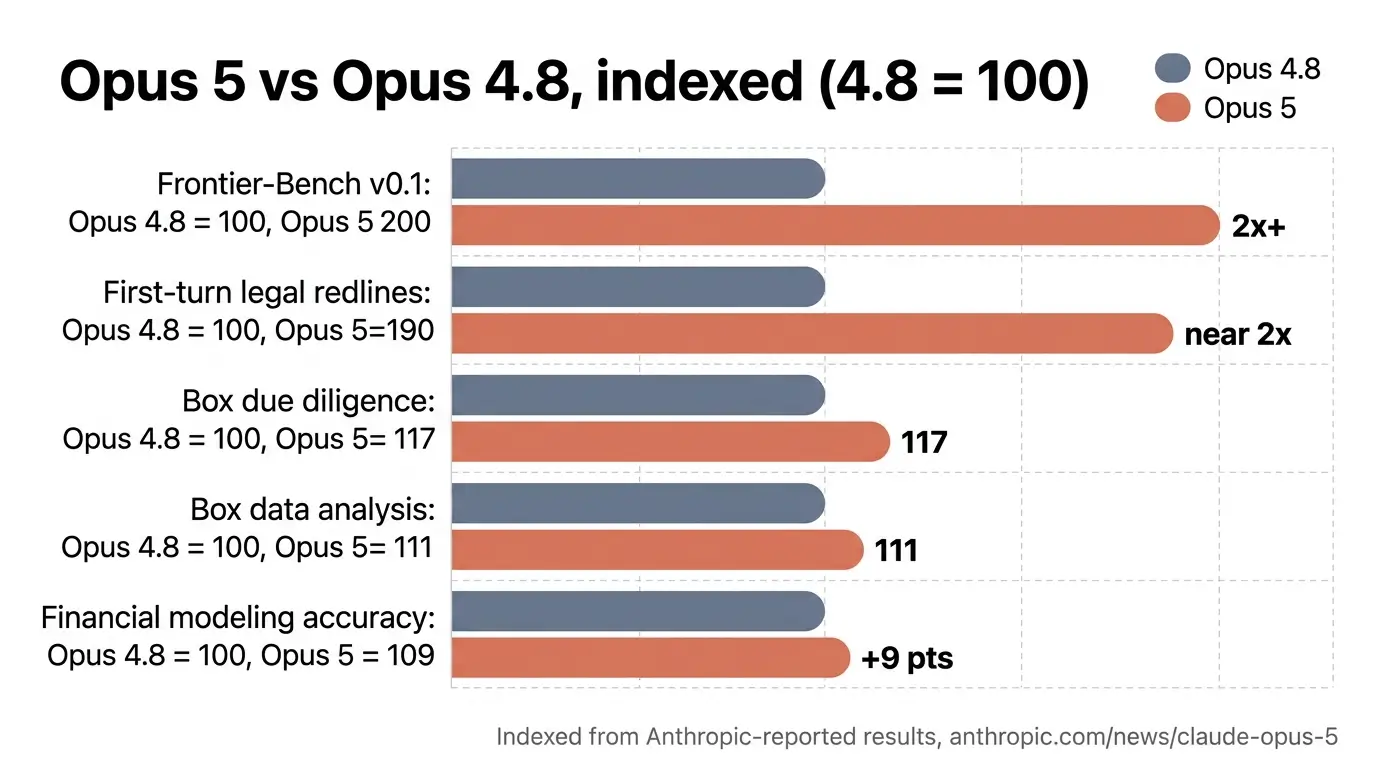
| Frontier-Bench v0.1 | Baseline | 2x+ higher, lower cost per task [1] |
| Financial modeling | Baseline | +9 points accuracy, a third fewer turns, 60% less time [1] |
| First-turn legal redlines | Baseline | Near 2x better [1] |
| Legal work at max reasoning | Baseline | Similar quality, 26% fewer tokens [1] |
| Box enterprise content evals | Baseline | +8% overall, +11% data analysis, +17% due diligence [1] |
| Trading benchmark (Anthropic internal) | Baseline | Higher score, ~1/7 the reasoning tokens, under half the latency [1] |
The pricing row matters more than it looks. Identical pricing = zero migration risk on cost. Your bill stays predictable while output per dollar goes up.
“But is it actually faster in practice, or just on benchmarks?” Fair question.
On Anthropic’s trading benchmark, Opus 5 scored higher than 4.8 while using roughly a seventh of the reasoning tokens and under half the latency [1].
Independent testing points the same direction. On FrontierCode v1.1, Opus 5 at medium effort was the most compute-efficient configuration tested, scoring 53.4% on the main split [6].
How It Behaves Differently
Scores tell you what a model can do once, on a test, under controlled conditions. What does living with it for two weeks feel like? Four patterns keep coming up in early-access reports [1][2]:
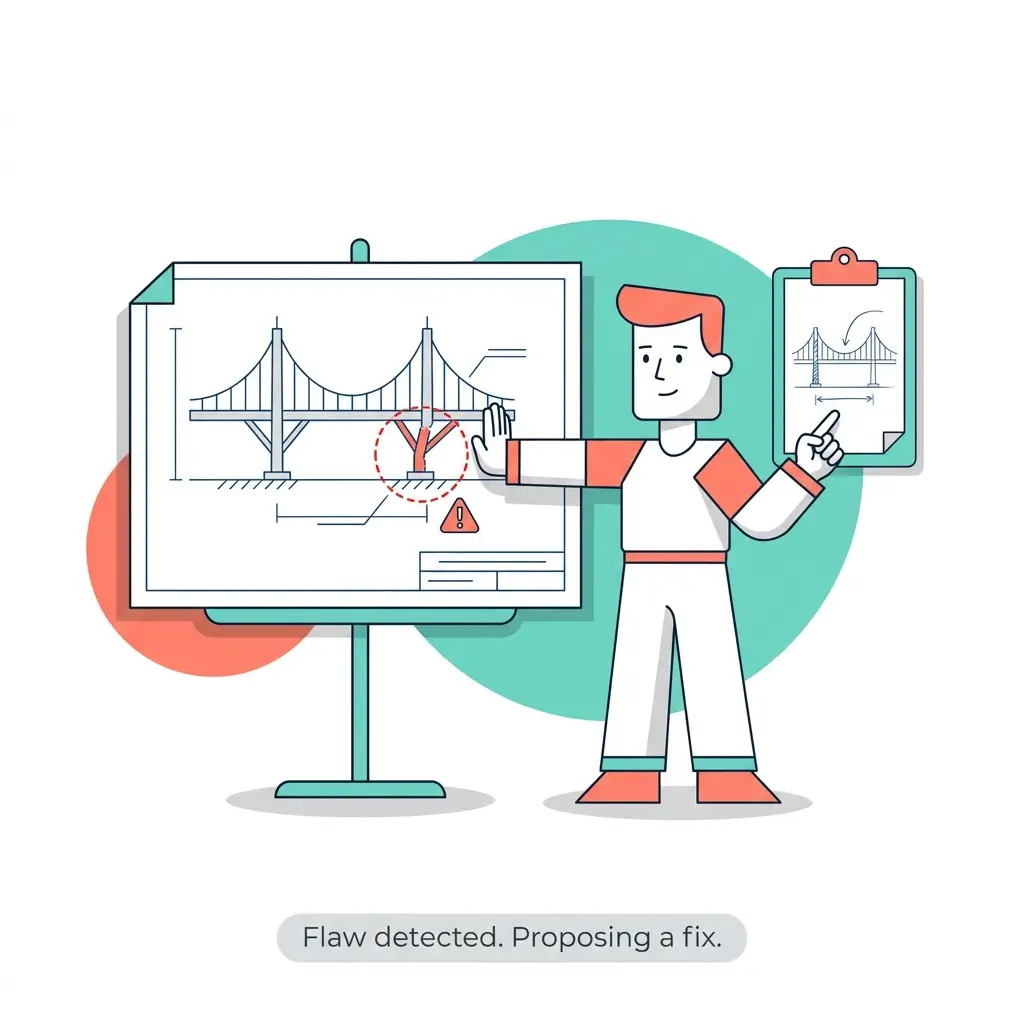
- It pushes back. Hand Opus 5 a flawed design and it says so, with reasons. Opus 4.8 would often fold the moment you insisted. A yes-man model is a bloody liability on a long project, and this fix alone changes how you delegate.
- It checks before handing off. It reviews branches and templates before presenting a pull request, instead of dumping code and walking away.
- It builds its own validation. When it cannot test against a live system, it writes its own test harness and works against that.
- It is steadier. Testers report it is a damn sight more consistent run to run. The tenth attempt looks like the first [1].
Anthropic also reports Opus 5 as its most aligned model to date, with lower deceptive-behavior rates and better adherence to its constitutional training, meaning the behavioral rules Anthropic builds into the model, than Opus 4.8 [1][2].
“Fine, but does it still hallucinate?” Yes. Every model does. The difference is frequency and self-correction: Opus 5 catches more of its own errors before they reach you. Verify anything that ships to production or a client, same as always.
The Caveats
Three of them, and they matter.
- Opus 5 is not the frontier. Fable 5 and Mythos 5 remain stronger on specific axes, particularly offensive cybersecurity and autonomous biology research [1]. Anthropic deliberately kept cyber training out of Opus 5, the same choice it made with 4.8 [2].
- The cyber classifier wall is real. Opus 5’s safety classifiers block binary vulnerability scanning, penetration testing, and exploit generation. Flagged requests route to another model by default, and that model is Opus 4.8 [2]. So: flagged request = automatic fallback to 4.8 = exactly the behavior you get today. If security testing is your workload, DO NOT migrate expecting an upgrade. Nothing changes for you.
- Sonnet 5 complicates the picture. Anthropic says Sonnet 5 matches Opus 4.8’s capability in some cases [3]. If your 4.8 workload never strained the model, your cheapest good option might be Sonnet 5, not Opus 5. Pay for headroom only if you use it.
(Ed. note: This third caveat is the one most likely to save you money. Run your actual prompts on Sonnet 5 before upgrading anything.)
Should You Switch?
Run through this list:
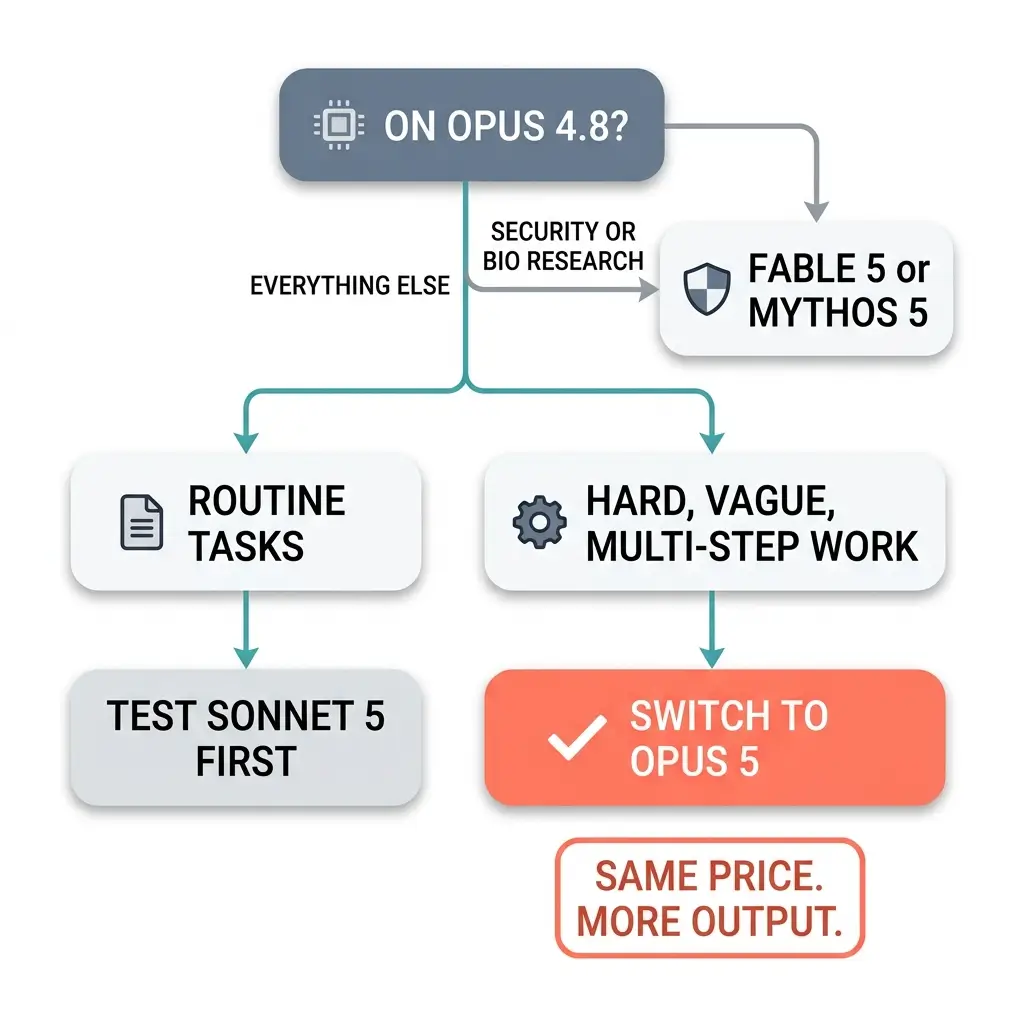
- You use Opus 4.8 today: switch. Same price, better output, no downside outside the cyber case above.
- Your work is hard, vague, and multi-step: agentic coding, end-to-end automation, judgment-heavy analysis. This is where the 2x gains concentrate [1].
- Your work is routine: summarization, simple Q&A, light drafting. The gap feels small here. Price out Sonnet 5 first [3].
- You do offensive security or autonomous bio research: look at Fable 5 or Mythos 5 instead [1].
When does an upgrade stop being an upgrade? When your workload never touches the parts that improved. If you run 4.8 on serious coding, research, or analysis, that is not you. Switch.
FAQ
Sources
- Anthropic, “Introducing Claude Opus 5”: https://www.anthropic.com/news/claude-opus-5
- Anthropic Docs, “What’s new in Claude Opus 5”: https://platform.claude.com/docs/en/about-claude/models/whats-new-opus-5
- Anthropic, “Introducing Claude Sonnet 5”: https://www.anthropic.com/news/claude-sonnet-5
- Anthropic, “Introducing Claude Opus 4.8”: https://www.anthropic.com/news/claude-opus-4-8
- RD World, “How Claude Fable 5 stacks up against Opus 4.8 and GPT 5.5”: https://www.rdworldonline.com/how-claude-fable-5-stacks-up-against-opus-4-8-and-gpt-5-5/
- SitePoint, “Claude Opus 5 Is Most Efficient at Medium Effort: FrontierCode Benchmark”: https://www.sitepoint.com/claude-opus-5-medium-effort-frontiercode-benchmark/
